Default APDU harness body for a fuzz target. More...
#include <stddef.h>#include <stdint.h>#include <string.h>#include <setjmp.h>#include "fuzz_defs.h"#include "parser.h"#include "fuzz_mutator.h"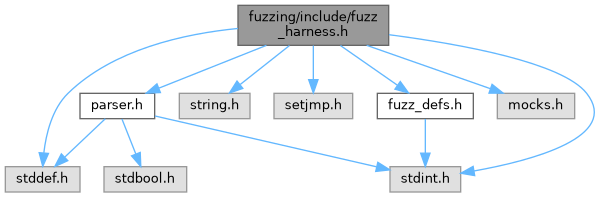
Go to the source code of this file.
Macros | |
| #define | FUZZ_APP_HEADER_LEN 0 |
| Bytes an app reserves for its own header, right after the control bytes. | |
| #define | FUZZ_PICK_COMMAND_STRUCTURED(data, size) (&fuzz_commands[(data)[1] % fuzz_n_commands]) |
| #define | FUZZ_PICK_COMMAND_RAW(data, size) (&fuzz_commands[(data)[1] % fuzz_n_commands]) |
Functions | |
| void | fuzz_app_reset (void) |
| Reset app state before each iteration (optional). | |
| void | fuzz_app_dispatch (void *cmd) |
Dispatch one command_t to the app (required). | |
| void | fuzz_app_cleanup (void) |
| Optional per-iteration teardown; the weak no-op default is in mock/fuzz_runtime.c. | |
| static int | fuzz_use_structured_lane (void) |
| Whether control byte 0 selected the structured lane. | |
| static uint8_t | fuzz_clamp_p (uint8_t raw, uint8_t p_max) |
| Clamp a raw P1/P2 byte to the command's declared maximum (0 = full range). | |
| static void | fuzz_harness_cleanup (void) |
| static int | fuzz_harness_entry (const uint8_t *data, size_t size) |
Default fuzz_entry() body: run one fuzzer input as one APDU. | |
| size_t | LLVMFuzzerCustomMutator (uint8_t *data, size_t size, size_t max_size, unsigned int seed) |
| Default custom mutator. | |
| int | fuzz_entry (const uint8_t *data, size_t size) |
Default fuzz_entry(), the symbol Absolution calls per iteration. | |
Variables | |
| const fuzz_command_spec_t | fuzz_commands [] |
| App command table. | |
| const size_t | fuzz_n_commands |
| Number of entries in fuzz_commands. | |
| static int | fuzz_lane_structured |
Detailed Description
Default APDU harness body for a fuzz target.
Including this header gives a target the standard fuzz_harness_entry() implementation: it turns one fuzzer input into one APDU and dispatches it through the app. The app contract is small and entirely about the app:
const fuzz_command_spec_t fuzz_commands[] = { ... };
FUZZ_COMMAND_COUNT();            // derives fuzz_n_commands
void fuzz_app_reset(void);       // per-iteration state setup
void fuzz_app_dispatch(void *);  // hand the built command_t to the app
fuzz_app_cleanup() is optional: the framework ships a weak no-op default that an app may override. Lane selection, command selection, P1/P2 clamping and the custom mutator all come from the framework. See fuzz_defs.h for the input layout — the harness takes its control bytes from the start of its own input, so nothing here or in an app ever needs to know where a global sits inside Absolution's prefix.
Definition in file fuzz_harness.h.
Macro Definition Documentation
◆ FUZZ_APP_HEADER_LEN
| #define FUZZ_APP_HEADER_LEN 0 |
Bytes an app reserves for its own header, right after the control bytes.
The APDU payload starts after them, so fuzz_tail_ptr[0] stays a stable base for the app's builders.
Definition at line 72 of file fuzz_harness.h.
◆ FUZZ_PICK_COMMAND_RAW
| #define FUZZ_PICK_COMMAND_RAW | ( | data, | |
| size | |||
| ) | (&fuzz_commands[(data)[1] % fuzz_n_commands]) |
Definition at line 81 of file fuzz_harness.h.
◆ FUZZ_PICK_COMMAND_STRUCTURED
| #define FUZZ_PICK_COMMAND_STRUCTURED | ( | data, | |
| size | |||
| ) | (&fuzz_commands[(data)[1] % fuzz_n_commands]) |
Apps may override these macros before inclusion to install lane-specific command tables.
Definition at line 77 of file fuzz_harness.h.
Function Documentation
◆ fuzz_app_cleanup()
|
extern |
Optional per-iteration teardown; the weak no-op default is in mock/fuzz_runtime.c.
◆ fuzz_app_dispatch()
|
extern |
Dispatch one command_t to the app (required).
◆ fuzz_app_reset()
|
extern |
Reset app state before each iteration (optional).
◆ fuzz_clamp_p()
|
inlinestatic |
Clamp a raw P1/P2 byte to the command's declared maximum (0 = full range).
Definition at line 57 of file fuzz_harness.h.
◆ fuzz_entry()
| int fuzz_entry | ( | const uint8_t * | data, |
| size_t | size | ||
| ) |
Default fuzz_entry(), the symbol Absolution calls per iteration.
Define FUZZ_APP_CUSTOM_ENTRY to write your own, for instance to add a non-APDU lane. Returning -1 makes Absolution skip its check_invariant() assertion for that input, so return it only for inputs you did not run.
Definition at line 176 of file fuzz_harness.h.
◆ fuzz_harness_cleanup()
|
static |
Definition at line 84 of file fuzz_harness.h.
◆ fuzz_harness_entry()
|
static |
Default fuzz_entry() body: run one fuzzer input as one APDU.
Reads the control bytes as lane/command/P1/P2 selectors, exposes the rest as the APDU payload, picks a command from fuzz_commands, and dispatches it.
- Returns
- 0 when the input was processed, -1 when it was too short to use.
Definition at line 100 of file fuzz_harness.h.
◆ fuzz_use_structured_lane()
|
inlinestatic |
Whether control byte 0 selected the structured lane.
Definition at line 51 of file fuzz_harness.h.
◆ LLVMFuzzerCustomMutator()
| size_t LLVMFuzzerCustomMutator | ( | uint8_t * | data, |
| size_t | size, | ||
| size_t | max_size, | ||
| unsigned int | seed | ||
| ) |
Default custom mutator.
Provided by the framework. A harness with its own input grammar defines FUZZ_APP_CUSTOM_MUTATOR before including this header and provides its own LLVMFuzzerCustomMutator(), usually built on fuzz_mutate_input_with() so it still does not have to know the prefix size.
Definition at line 161 of file fuzz_harness.h.
Variable Documentation
◆ fuzz_commands
|
extern |
App command table.
◆ fuzz_lane_structured
|
static |
Lane of the input being dispatched; set before fuzz_app_reset() runs.
Definition at line 48 of file fuzz_harness.h.
◆ fuzz_n_commands
|
extern |
Number of entries in fuzz_commands.